show your support


Training Your Dog To Sit - Proven Training Techniques
Training your dog to sit on command is a good place for you and your dog to start your obedience training. It's a nice easy command which your puppy or dog will master very quickly. This will increase your dog's confidence and provide the foundation on which to build more advanced skills and commands.
Another benefit of training your dog to sit is that it gives you a good alternate behavior to request of your dog. If your lovely dog likes to greet visitors to your home by jumping up all over them, or charges out the front door every time it opens, you can gain control of him by applying your "sit" command.
You can start with this obedience command as soon as you bring your new puppy home, or any time after that. Before you start training your dog to sit (or any other obedience command) ensure that your dog is confident and comfortable around you - lets you touch him, gives you his attention etc.
[google_ad:DOTR_CMS_468x60_InArticle1]
General Rules To Remember When Training Your Dog To Sit
- Keep your training sessions short. Five minutes is plenty to begin with, especially when teaching a young puppy.
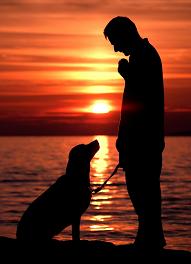
- Any time is a good time to practice really, you don't have to structure all your lessons. Incorporate the training into your daily routine. Get your dog to sit before you feed him or make him sit before you throw his ball at the park. When applied in this manner obedience training will be fun in your dog's mind, and also rewarding.
- Make it perfectly clear to your dog what you are asking of him - what you want him to do.
- Make training your dog to sit fun, don't make it feel like a chore, for you or your dog.
- Training sessions should be full of consistent repetition, praise and positive reinforcement.
- Don't expect your dog to immediately learn this, or any other obedience command and then never forget it. It's up to you to reinforce the meaning of your command through repetition and consistency throughout your dog's life.
- Gradually faze out the food rewards you may use in the learning period of a new command. Giving a food treat or reward every now and then doesn't hurt your dog though, even if he responds to your commands without one.
- When training your dog to sit for the first time, make it easy for him/her to succeed. Start your training sessions in a familiar environment to your dog, free from other distractions. Master the command in this setting, then slowly make it harder for your dog. Add other variables, throw a challenge out to your dog such as taking the training session to the park or increase the duration of the sit.
Training Your Dog To Sit - My Favorite Techniques
I have three techniques I like to use when teaching my puppies or dogs to sit. I've had a 100% success rate with these techniques and I'm sure you will too. Pick out the one that best suits you and your dog, and you'll be well on your way to having a well behaved dog.Technique 1
This first training technique is great for young puppies. When you are with your pup and you see him about to sit or in the act of sitting, say "sit" in a clear and firm tone. As soon as your dog's rear end hits the floor, give him praise and maybe a bit of a scratch behind the ear. In your dogs mind you are building an association between your verbal "sit" command and the act of him sitting.Most puppies make this connection very quickly. Before long you will be able to say "sit" at any time, and your puppy will understand what you are asking of him. Remember to always reward and praise your pup as soon as his behind hits the floor. Your pup will love it, he'll be thinking "all I have to do is sit down and I get attention, treats and praise!"
Technique 2 - Off Leash
For older puppies and dogs this training technique works every time. With your dog standing right in front of you, grab a small tasty treat in your hand. Guide the treat from his nose level up over his head, the treat should be a few centimeters away from your dog at all times. Your inquisitive dog will follow the treat up with his nose and at the same time his rear end will hit the ground. As soon as his behind hits the ground give him the treat and lavish him with praise.If your dog backs away or jumps up at the treat you are taking your hand too far back over his head, or holding it too far away from his nose. Repeat this step until your dog gets it, then you can introduce the verbal part of the command. Just before you begin to move your hand (the one with the treat in it) say "sit". Your dog will soon respond to your verbal "sit" command without even moving your hand. Remember to practice/reinforce this command at any time throughout the day, in any situation.
Technique 3 - On Leash
If your dog doesn't respond to the methods outlined above, or if you prefer to use a collar and leash in your training, this technique will do the trick.Stand next to your dog, both of you facing the same way. Hold the leash straight up, directly above the collar. At the same time gently press down on your dog's back (down near his hips) and say "sit". As soon as your dog is in the sitting position, reward and praise him. Within no time you won't need to press down on your dog's back or even hold the leash up. He will understand that your "sit" command means that you require him to plant his backside on the ground. And he'll be happy to do it for you because he knows that he receives praise and attention when he does.
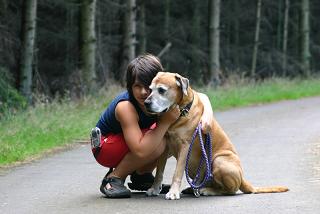
I hope these techniques prove successful for training your dog to sit, I'm confident they will. It's a good idea if you live with other people to teach these commands to them as well. They can then apply the exact same commands to your dog - your dog will appreciate this consistency.
If you plan on training your dog at home, and would like to do it the right way please consider using this complete dog training package. I have found it to be a very effective tool in helping me train my own dogs, and also strengthen the bond I share with them. It's a great community of dog lovers run by professional dog trainer Daniel Stevens.
Some Other Pages You May Be Interested In:
Are you feeding toxic dog food - what is the best dog food?
Are you looking after your dog properly? - Dog health care tips
Check out some more dog obedience training commands.
Please consult the services of a Professional Dog Trainer, Behaviorist or Veterinarian before implementing any of the advice contained on this site.


Receive free ebooks and resources from world leading dog trainers
Hot Content


Recently made posts
-
Forum: Introduce Yourself Posted By: Sheppard wolf Post Time: 04-26-2018 at 09:44 PM
