show your support


The Proper Way to Brush Your Dog
[google_ad:DOTR_CMS_468x60_InArticle1]
Health Benefits When Brushing Your Dog
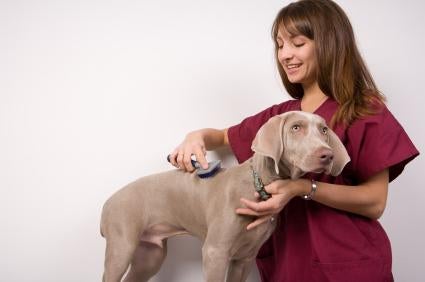
Regular brushing gives you the chance to get to know what your dog's body is normally like. You should always spread the hair apart to look at his skin and feel for any new bumps, lumps, or abrasions while grooming. If you brush your dog regularly, you will be more likely to notice a change in his skin or body. Many bacterial infections, insect bites, or skin cancers start with just one or two new bumps.It is important to brush your dog to keep his hair mat free. Mats form when you allow your dog's hair to tangle. Think of it like dreadlocks. Mats are tight wads of hair that are hard to separate. They grow larger and larger if not removed. Mats also form tightly to the skin, making them painful over time. They can become smelly, harbor insects or debris, and create numerous skin problems. Mats should always be carefully removed with a mat breaking grooming tool or carefully cut out with a pair of scissors.
Another health benefit is relaxation. Dogs loved to be brushed, especially when started early on and done regularly. It massages the skin, loosens up dry skin, and feels wonderful. Many dogs experience a real relaxation from it. If you combine your brushing with sprays formulated from essential oils like lavender or chamomile, the aroma has relaxing properties too.
Dog Brushing - Tools You'll Need
What kinds of tools are necessary really depends on your dog's breed type.Double coated breeds have a thick undercoat which is shed out twice a year. It is important to get all of this undercoat out of the dog or it will mat. The best tools for this type of coat are a rake, comb, and a Furminator de-shedding tool.
Terriers and wiry coated breeds have hair that is rough in texture and doesn't shed the same way as a normal dog. Terriers normally have hair plucked out or stripped to keep their coat texture true to nature. The best tools for these coats are a pin brush, a stripping grooming tool, and a flea comb. A flea comb has tightly set teeth, and it will grab dead hairs and pull them out as you comb.
Silky coated breeds like Yorkshire terriers and Maltese have hair, not fur. It will continue to grow and grow and it has a very silky texture. These dogs need pin brushes and combs to keep the hair tangle free and in top condition.
For shorter coated breeds like retrievers, slicker brushes and Furminator de-shedding tools work very well, as do hound gloves.
How to Brush Your Dog
In order for your dog to enjoy the process, it is important to introduce them early and in a positive manner to the tools and process of being brushed. With a puppy that has never been brushed, combine light brushing with something positive like some yummy treats or toys. Focus the puppy on the treat in your hand and lightly stroke once or twice with the brush. Only do this a few times in the beginning and slowly build up as your puppy's tolerance level builds.Dogs that are not used to being brushed often have to be acquainted to the brush the same way as a puppy. Always try to exercise the dog first through a good walk or playtime to wear out some of his excess energy. Then, lightly brush a few times while keeping the dog focused on food or toys.
Keep initial sessions to just a minute or two. If you force a dog to be brushed when he's not comfortable, you will create a lasting bad impression on your dog. For any kind of dog, start with a brush like a pin brush or a rubber brush like the Zoom Groom. These might not be the tools you will most frequently use as the dog becomes used to the process, but they are both very gentle and feel good to the touch. The better an experience your dog has initially with brushing, the more he will enjoy it overall.
A Few Dog Brushing Notes
There are a few things to keep in mind when brushing your dog:- Brushing should be done very regularly. With silky breeds, they should be brushed everyday. Other dogs should be brushed at least 2-3 times a week.
- Be especially careful around sensitive areas like the groin, stomach, and arm pits.
- Brush with the way the hair grows! Don't brush against the grain or you might pinch the dog's skin with the grooming tool, pull out too much hair, or cause discomfort.
- If you find a small tangle, you can attempt to gently separate it with your fingers and use a comb to remove it. You can also spray the coat with a conditioning de-tangling spray or rub cornstarch into it. This will often make it easier to brush the tangle out.
- For larger tangles or mats, you can try to use a mat breaker comb to split the mat apart or use small scissors to cut it out. Be very careful! You can cut your dog's skin. You should always lift the mat, place your fingers below it, and then use the scissors to cut between your fingers and the mat so as to not cut your dog's skin.
Regular home brushing is a great way to have bonding time with your dog. It keeps his skin and coat healthy and gives you a heads up on any suspicious lumps or bumps you might find.
Plus, the more you brush, the less little hairs are floating all around your house!
Some other pages you may be interested in:
Learn how to properly obedience train your dog.
Solve your dog's behavior problems such as excessive barking, digging, chewing, whining and jumping up on guests.
More dog grooming information.
Please consult the services of a Professional Dog Trainer, Behaviorist or Veterinarian before implementing any of the advice contained on this site.


Receive free ebooks and resources from world leading dog trainers
Hot Content


Recently made posts
-
Forum: Introduce Yourself Posted By: Sheppard wolf Post Time: 04-26-2018 at 09:44 PM

 Your Privacy Choices